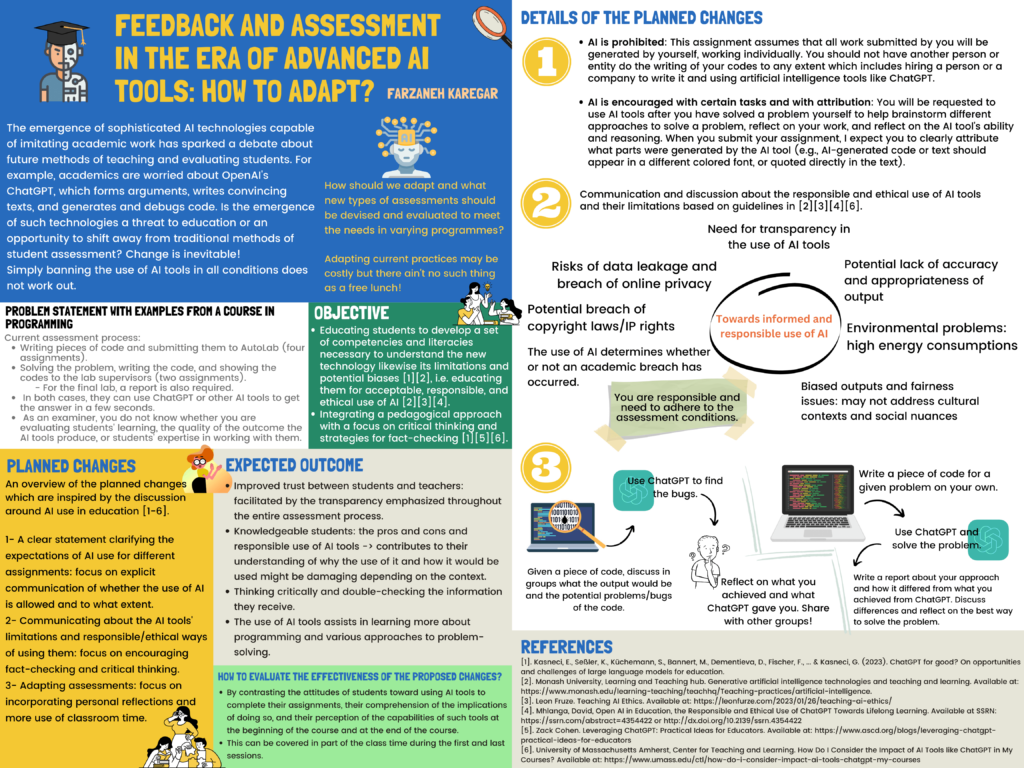
Near the end of the ONL course, it appeared that I luckily had registered and participated in the course at the best time unwittingly. When I was thinking of enrolling on the course, I was curious to know how an online course would be managed and how we would interact with others from different parts of the world. Yet I did not know that soon I would be involved in designing and implementing an online course myself and that I would have the chance to practise the lessons learnt through the ONL course for real momentarily.

As part of the ISE project at Karlstad University, my colleague, Agnieszka Kitkowska, is leading the planning, designing, and implementation of an online course for Fall 2022 (week 38 to 48) on consumer privacy that targets working professionals who want to learn more about the topic and who process digital information about consumers. The course consists of four modules (the fourth module is the recap of the lessons learnt through the course). I got invited to collaborate on preparing the course and now I am in the process of preparing materials for the first module which revolve around privacy constructs and definitions, data protection and data protection models, and usable privacy. Besides the asynchronous learning activities that include reading materials and watching (pre-recorded) videos, the course will involve participants in four synchronous seminars related to each module which will also serve as a form of examination of the learning outcomes of the course.
It was an exciting moment when I heard about the opportunity of getting involved in preparing and running the course since I immediately remembered all the sessions I had with my group in the ONL course and I got intrigued by the idea of applying what I learned in practice. However, soon I realized that lots of concepts and methods we learn in theory are too good to be true when we want to apply them in practice. I mean although on paper they seem straightforward and very beneficial for students and instructors, sometimes with a low cost of implementation and not too much of a hassle, in practice you face unforeseen challenges and open questions.
The audience of our course, as mentioned above, is different from other typical online courses. They will be working professionals in the private or public sectors interested in the topic who want to improve their competence for their careers. Their professional and educational backgrounds could be extremely diverse with variations in their digital literacy. To have a more inclusive environment and make sure that everyone would benefit from the course to the extent we expect despite their differences, we will have an introductory session focusing on practicalities, the tools we will use and useful instructions around them, and probably a community building activity so they feel more comfortable for their upcoming seminars to talk, interact, and work with each other. Also, we may utilise the session to learn more about them, their needs, and their expectations of the course. Although we will have a draft plan for each seminar in the course in advance we believe that we need to keep it open and keep some room for changes after we get to know more about our audience. The use cases to be worked with during the seminars, the type of the assignments, and even the time for holding each seminar should be adaptable. Although it means more work for us as instructors in a shorter period to adapt the plan, it is rewarding for the participants.
The balance between asynchronous and synchronous activities in this course is very important and a little bit challenging to achieve. Participants will have time to go through the materials for each module on their own and will take part in a synchronous interactive seminar related to each module for which they receive instructions on how to get prepared. The details of the assignments and how the seminars will be held are under discussion. Nonetheless, what I learned from Topic 3 on collaborative learning and Topic 4 on blended online learning and different tools and activities will play an important role in our planning for the course. Again, what we plan is tentative and will be adapted after we get to know more about our participants and progressively by the feedback we collect during the course.
Further, by this course, we would like to contribute to open education. We plan to have non-disposable assignments for our seminars and use and extend open educational resources, if possible. Finding open resources of good quality that fit our needs and fulfil our purposes is not an easy task. Our pre-recorded videos will be accompanied by a recommended list of reading consisting of open access articles (and books). However, again considering our target group, we believe that delivering content in the form of audio to listen to will be more convenient for them than something they need to read. Due to their busy lives, they may choose to listen to some of the resources when, for example, they are walking, driving, cycling, or public-transferring home. We are looking for related podcast episodes and plan to interview professionals in the field of privacy, both in academia and industry, related to the topics covered in the course.
Always realize that you can get better. Your best work has not been done yet. Practice! Practice! Practice!
Les Brown
For the upcoming months, I will be busy repeatedly referring to the ONL website and all the materials we got to learn and produced together including the final Mirro. Hopefully, with a well-thought-out and flexible plan ready to accommodate changes based on needs and feedback our participants in the course and we as instructors will have a nice experience.
In our group (PBL#3), much of our discussions for Topic 4 revolved around synchronous and asynchronous online learning activities, their benefits and challenges, and tools to implement them. Our discussions intrigued me to think deeper about the abrupt movement from on-campus courses to online courses due to the pandemic and the challenges different stakeholders in academia, from students to study directors, faced. Among all, I was more specifically thinking about the immediate attention the videoconferencing tools received and the one-to-one mapping of activities probably lots of instructors all around the world tried to make between their previous teaching (learning and assessment) activities and an equivalent online one. The most straightforward mutation for all activities that required the presence of students at one place at the same time is to use an online platform mandating synchronous interaction of its users such as videoconferencing tools, let’s say Zoom.
Have you ever gotten tired of all the Zoom meetings you had in a row at your job? Have you ever experienced a situation in which you spent lots of time and energy preparing and conducting a Zoom meeting with your colleagues and it was in vain without concluding anything (that if it was held face-to-face, at your workplace, communication would be easier and more fruitful)? My answers to these questions are “yes, unfortunately, several times”.
Zoom fatigue and its consequences are most probably not just real for me but my students and likewise for you and your students. Zoom fatigue is the popular and brief replacement for the more generic term “videoconference fatigue” and it refers to the experience of fatigue during and/or after a videoconference, regardless of the specific video conferencing tool used. LIbby Sander and Oliver Bauman have described in their blog post how Zoom meetings are different from in-person meetings and discussed that Zoom meetings, due to their specific attributes, take up a lot of our conscious capacity and they increase our cognitive load. Therefore, when we think about synchronous online learning activities we should not immediately select to have Zoom sessions as if other instructors do the same students end up with nothing but fatigue. If we do so, we also unwittingly discriminate against some of our students. A group of researchers at Blekinge University studied Zoom fatigue and concluded that young introvert women are affected more than others. But the question is what to do instead?
The easiest and maybe even the most frivolous answer is not to use Zoom or UnZoom. Of course, under the pressure of very limited time and resources, Zoomification of education is perhaps one imperfect and temporary solution and, understandably, we cannot easily rethink the design of our courses and we go with the most straightforward solutions. However, knowing different types of synchronous and asynchronous activities and tools and when it is suitable to use them can help us make better decisions considering what we expect our students to achieve in our courses. For example, not all contents we deliver in our synchronous lectures need to be delivered synchronously. We may provide students with recorded videos (if feasible for us) or find and use open educational resources that students can refer to them asynchronously. After a period given for watching the videos or going through the other materials provided, we may hold a workshop/seminar to synchronously interact with our students and engage them in active learning and discussions and guide them through critical thinking activities in which they can apply what they’ve learned. During the workshop(s) we can use, for example, Padelt, Menti, and Google docs and ask students to reflect on what they have learned and find if we need to review some parts or emphasise specific aspects.
Our teaching practices should be dynamic and adaptable based on the situation with the focus on approaches that maximize student engagement and consider students through the whole development cycle of designing or redesigning our courses and not with the focus on the easiest and shortest path to do the tasks on our plate. I want to conclude my post with a quote by Terry Heick:
“The best teachers are the ones that change their minds”
Terry Heick
and I provide some useful links for you if you are motivated to rethink your approaches in your online courses.
Useful resources:
Online Tools for Teaching & Learning
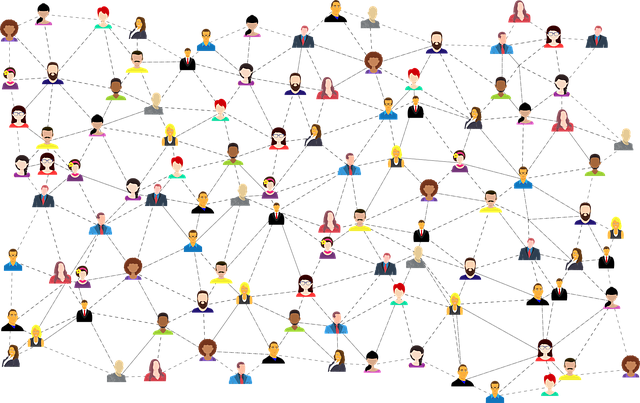
I know myself as more of a visitor to the digital world than a resident. I have been always cautious of what I share online, to whom, and for what purposes. I have also been worried about how the information I share, the people I follow, the friend requests I accept, and the “thumbs up” buttons I press form my online identity and make a new “me” which may contradict the “true me”. Nonetheless, with the pandemic and the steep decrease in face-to-face and in-person communications, I realized that I needed to connect to people differently and push the boundaries I created for myself beforehand. The impossibility of travel and working from home created more free time for me which I devoted to social media usage, mainly Instagram and Twitter, sometimes unwittingly as just a habit. In the beginning, I was straying and aimlessly surfing through different pages and profiles. If you do not control what you would like to be exposed to then the platform and its algorithms will control you and you will be bombarded with unwanted information.
At some point, I realized that I needed to gain more from these platforms considering the time I spent on them. I started playing around with the control functions available on these platforms. I realized that for my research and my profession I could benefit more from Twitter and for my interests and hobbies from Instagram. I tailored the “Topics” of interest on Twitter to receive more relevant tweets and defined what I am not interested in. I started using Tweetdeck and followed the hashtags more wisely related to my field of research. I also started following people who were actively doing research in my field and energetically tweeting about interesting related topics and events. On Instagram, I benefited from defining a “Favorites” list. If a person whom you follow is on your favourite list then their posts are shown higher in your feed. In this way, if you limit the time you would like to spend on Instagram and you start exploring your feed then you can utilize your time better. Bookmarking interesting posts and structuring them into different categories also helped me return to them as needed easily without spending much time. The nature of the interaction I am mainly involved in for the networks I have created for myself is one-to-many (I am one of the many who is the receiver of the info) or one-to-one (direct messages transferred between me and people I follow). I mainly consume the knowledge and information than produce it. However, these platforms and other social networks (or software) provide other forms of interactions and functions as well. Dron and Anderson, in their book on Teaching Crowd, provide two interesting tables. The first table (Table 1.1. in the book) lists a range of families of social software and their categorization by the predominant forms of social engagement they provide. The second one (Table 1.2) presents a list of functions social networks provide which benefit can facilitate learning and benefit learners. I recommend interested readers to check this book out.

I am also following some Telegram channels posting about the topics I am interested in. Although I may not have time to check all of the posts, when I get the chance I skim through some of them and it is a quick and convenient way of getting a hand at new things happening around the world in different contexts.
Recently, one of the social influencers I follow took the initiative and made a post dedicated to friendship and asked all of her followers who were searching for other people to meet, make friends, do activities together, learn new things, and generally socialize to introduce themselves and their interests with a comment on the post so others with common interests could find them and form a group. Due to the given circumstances and considering the geographical distance between me and her followers I assumed my comment would be in vain but it turned out to contradict my initial predisposition. On public pages I never comment or at least I cannot remember if I did previously but sometimes it is beneficial to push the boundaries, make a quick decision, and go for it.
In the ONL (open-networked learning) course, when we started our discussion regarding openness, open education, and open learning, it was revealed from the beginning that people had different interpretations and understanding of open education and open educational resources (OER) and practices. For example, open education may just be a buzzword for some people, seen as a way to save money for others or something that reminds them of licensing issues, to name a few. In my opinion, although it is not a problem to have a different understanding of this concept, the benefits and the impact of practices associated with different definitions differ tremendously. Benefits or challenges of open education and pedagogy can be discussed if only we come to a consensus about their definitions. Otherwise, we would apparently talk about the benefits and challenges of different things.
All that glitters is not gold or as we say in Persian “not every small round object is a walnut!”. There are probably several misconceptions about the idea of open education. In the following, I discuss the ones that I noticed which are even common among scholars:
 Online means open. Sometimes open education is easily misunderstood with online education. Online technologies foster open education. Without the Internet, open education would not have all of the benefits it has now. However, online education is different from open education. For example, during the pandemic, lots of universities transformed their courses from on-campus courses to online courses, e.g. given via Zoom but those courses are not open courses accessible for all and may not use OER. Another example is the distant courses different universities offer that can be categorized as online education but not necessarily as open education. They are closed courses for students who enrol and pay for their education and the resources may not necessarily be open resources accessible for all and modifiable. Online education does not necessarily have the equity and inclusion benefits of open education.
Correspondingly, not all MOOCs are open (even if advertised to be so) because they are produced based on copyrighted content that does not fulfil the requirements of the OER definition. Learners in lots of MOOC courses can only access the content but cannot reuse or modify it. In addition, in a world that assesses your qualifications based on your degrees and certificates, the ultimate benefits of taking a MOOC are only achieved when you receive a certificate that is not in most cases freely issued.
Freely available means open. Another misconception about open education is related to the availability and accessibility of resources. In other words, the concept of openness can easily be misunderstood by the idea of the freely available information in any format. OER should be openly licensed, freely available, and modifiable. If we assume that using freely available resources which are not modifiable is one way of practising open education educators will not be free to edit, reorder, and remix OER materials in many ways. Thus, the benefits of using such resources will be far more limited than using OER.
Creative Commons (CC) provides free open licences for creators to use when making their work available. Creative common licenses are understandable by humans. The layer we as users of the works or creators see is jargon-free, symbolized, and simple. However, whenever we see a CC symbol we should not by default imagine that the resource is modifiable or OER. Also, we should not forget about attribution. Unless licensed under CC0 1.0, we cannot use the recourse without attribution.
Open education and open pedagogy are ongoing movements. Their success is dependent, among other things, on endeavours to counter misconceptions and promote their key values. Considering all misconceptions and different incorrect interpretations of OER I can agree with people who think it is widely spread and used worldwide. Nonetheless, if we stick to the key values of OER and open education we have still far to go.
People define, express, and represent themselves through their profiles, interactions, relationships, and their networks online. In other words, users’ online activities form their digital identities. Social media makes new opportunities and challenges related to the digital identities of users either professional or personal. The professional identity of an individual on a social media platform means representations of the professional activities, affiliations and work-related norms that a person presents. Personal identity, on the other hand, is any activities, opinions or relationships that represent a person beyond their professional activities. However, there is not always a clear separation between professional and personal identities on social media platforms. For example, Twitter is a social media platform used widely among educators. It is also an important communication channel for journalists and politicians. But how do these people use Twitter and how do they represent themselves? Do their profiles and activities on Twitter reflect their personal or professional identities? How do they separate the representations of their professional and personal identities? Are they recognised as they wanted to be identified? How do their digital identities affect their audience and what they learn and grasp from their accounts? There are several important questions in this context to be addressed.
Bossio and Sacco [1] discuss that representing personal and professional identities online might be especially difficult for journalists. They interviewed 30 journalists to analyse how they negotiate representations of their professional and personal identities on social media platforms. Their results show that journalists present their identities on social media in three different ways:
a) creating public and professional accounts and having secondary, private accounts that are only accessible to personal networks,
b) maintaining public accounts dedicated to professional activities, and
c) merging professional and personal identities on publically available accounts [1].
In an interesting study, Carpenter et al. analyzed profiles and tweets from K-12 teacher Twitter accounts (n = 33,184) to investigate how the accounts were used for personal and professional purposes [2]. The analysis revealed that the majority of the teacher Twitter profiles distanced professional identities from personal beliefs or affiliations. Carpenter et al. [2] discuss that teachers separate aspects of their personal identities that they perceive as potentially having positive professional impacts (i.e., family roles) from aspects that could be more controversial (i.e., religious or political affiliation). However, the lack of personal representations could restrict teachers’ interactions and the networks they develop with other educators on Twitter and it may consequently restrict the students’ benefits [2].
Here I would like to continue with a reflection on my personal experience regarding using Twitter for professional activities. I always wanted to actively maintain my Twitter profile and build a space where I could communicate with other people in the field and learn from the current state of the art in usable privacy and security research. Despite my initial motivation I never succeeded and I found it less straightforward than what it looked like at the beginning. I was weighing two options as two separate potential directions to select:
1- making a complete separation between professional and personal activities (e.g. just tweet, retweet, and like the tweets related to my work),
2- having a combination of both representations of my professional and personal identities in my profile and through my activities on Twitter.
I knew that there would be another option of making two different accounts and devoting each to representing either my professional or personal identity. Nonetheless, having two separate accounts would be too much for me to handle and it might end up in at least one inactive account.
Another problem was related to the language. I have my colleagues following me on Twitter. At the same time, I follow some of my Persian friends and have them as my followers. When they like Persian tweets I see it in my timeline and sometimes I am intrigued to like those tweets. But if I like a Persian tweet it may appear in my colleagues’ timelines and they may find it irrelevant and annoying.
Further, I found it drastically hard to make a separation between the professional and personal representation of myself. If others with whom you are communicating (e.g. your followers and whom you follow) do not make a distinction between personal and professional identities you will be affected as well. People whom I followed were retweeting and liking tweets in different contexts. When surfing through my timeline on Twitter I could see ranges of different tweets and I was unintentionally reacting to some.
I was also to some extent concerned about my privacy and what others could learn about me and my opinions and attitudes on different matters from the tweets I like. On Twitter, if your account is public everyone can see the tweets you like and I assume it can tell a long story about the person holding the account. I have seen some people announcing that their opinions on Twitter do not represent their employer’s opinions (i.e. their tweets are their own) or their thumbs up for tweets do not mean endorsement. But we like it or not, people are entitled to interpret themselves what an action means. All of these activities form our digital identity whether we mean it or not.
The aforementioned reasons made it hard for me to have a clear separation between my professional and social identities and propelled me to be less active on Twitter than I initially intended to be. However, I think that I am not the only one struggling to negotiate representations of my professional and personal digital identities and make an appropriate balance between disclosure and maintenance of boundaries. One thing that is currently missing is up-to-date, evidence-based pieces of advice on how to manage the challenges the technology creates for balancing personal and professional boundaries. How you do relate? I would like to hear about your experience and your view.

References:
[1]. Bossio, D., & Sacco, V. (2017). From “selfies” to breaking tweets: How journalists negotiate personal and professional identity on social media. Journalism practice, 11(5), 527-543.
[2]. Carpenter, J. P., Kimmons, R., Short, C. R., Clements, K., & Staples, M. E. (2019). Teacher identity and crossing the professional-personal divide on Twitter. Teaching and teacher education, 81, 1-12.
© 2026 Farzaneh's blog
Theme by Anders Noren — Up ↑