
The Hidden Burden of Morphological Deprivation in Small and Medium Cities
These results and visuals are based on version 1 of the preprint. They have been updated after revision. For the updated document and figures, refer to the publication:
When we map urban deprivation, we usually focus on the world’s largest capitals. But we found that his leaves a massive blind spot.
We are happy to share the preprint of our latest research: The Hidden Burden of Morphological Deprivation in Small and Medium Cities (currently under review at Nature Cities).
Link to preprint: https://www.researchsquare.com/article/rs-8189204/v1
Summary
Global monitoring of urban deprivation often centres on megacities – the giants of urbanization. But does this capture the full reality? By leveraging machine learning and the City Segments v1 dataset to analyse 5000+ cities across 100+ countries, we uncovered a critical piece of the puzzle that often goes unnoticed.
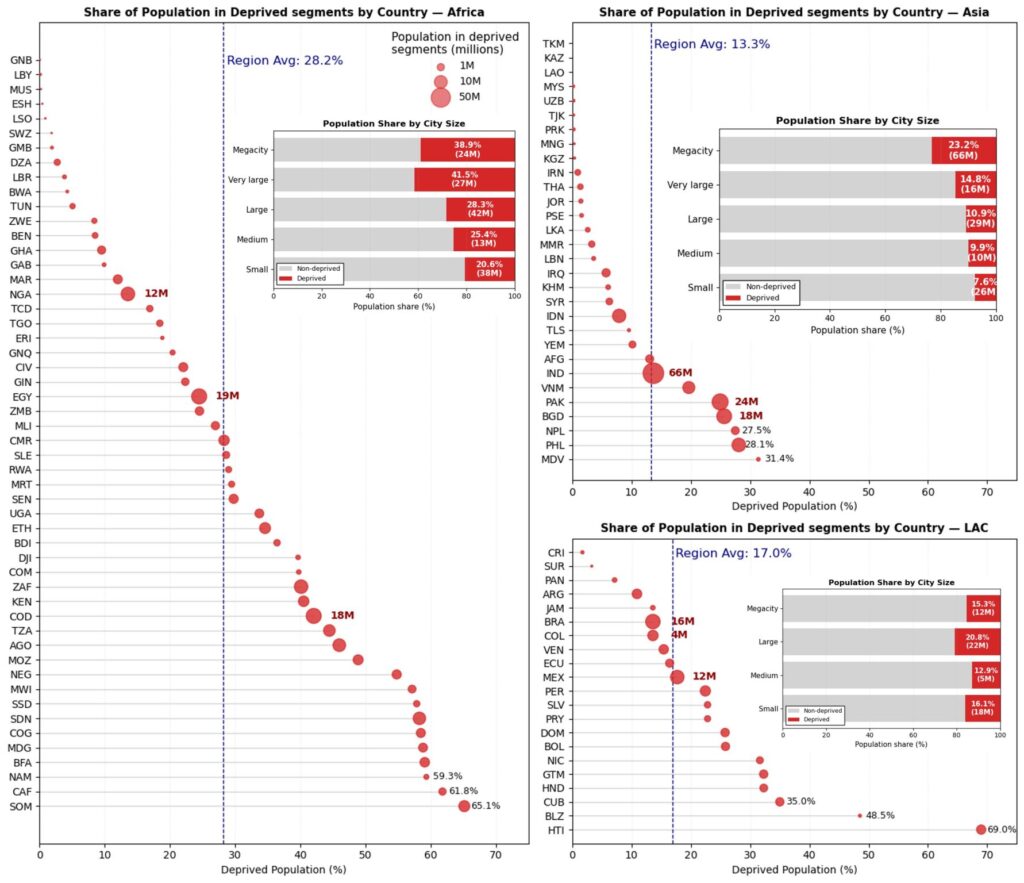
Our analysis shows that 32% of the population living in morphologically deprived neighbourhoods is located in small and medium-sized cities.
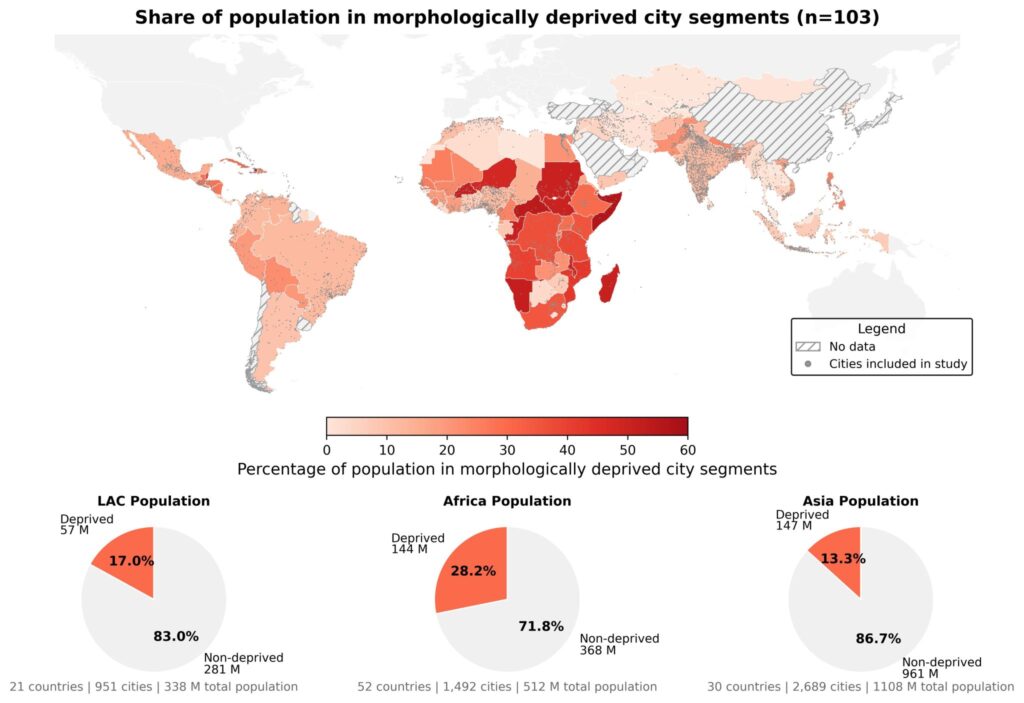
These are cities that rarely make global headlines. They often lack the financial and technical capacity of megacities to manage rapid growth, yet they house a significant portion of the 349 million residents we identified as living in morphologically deprived neighbourhoods across Africa, Asia, and Latin America & the Caribbean.
Key highlights:
- 🌍Global Scale: We produced the first neighbourhood-scale spatial estimate of morphological deprivation for over 5000 cities.
- 📉The ‘Missing Middle’: While Asia holds the highest absolute numbers, Africa faces the highest relative share of deprivation, spanning all city sizes, not just the capitals.
- 🎯Policy Impact: To truly meet SDG 11, we argue that funding and policy must decentralize, shifting attention to these smaller, rapidly growing urban areas that have been historically overlooked.
This work is a collaborative effort. A huge thanks to the co-authors Alex Blei, John Friesen, Bedru Tareke, Monika Kuffer, Claudio Persello, Raian V Maretto, Angela Abascal, Stefanos Georganos, and Dana R Thomson.


No responses yet