Stefanos Georganos gave a lightning talk titled 'Mapping SDG 11.1.1 using Earth Observation and Machine Learning' at the SESAC Open Session 1 held on 27 March 2026. Stefanos gave an overview of different projects under the IDEAMAPS Network umbrella.
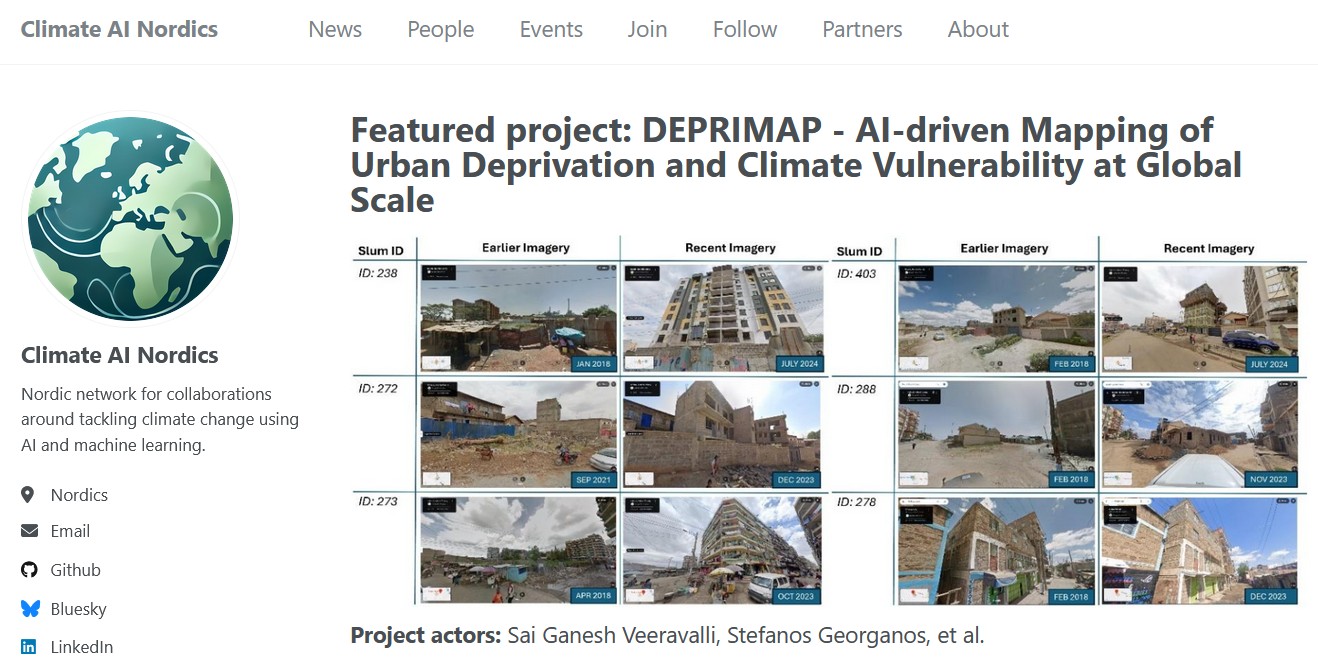
Thanks to Climate AI Nordics for featuring our project and my PhD research DEPRIMAP in the monthly newsletter. The featured project webpage provides an overview of the DEPRIMAP project and its planned implementation in three phases

Stefanos Georganos attended the launch event of SESAC (Swedish Competence Centre for Satellite-Enabled Social Science Analytics) on March 5, 2026, at Lund University, Sweden. Two posters were presented at the event.

Our work on 'The Hidden Burden of Morphological Deprivation in Small and Medium Cities' was highlighted by our collaborators at Human Planet Forum 2025 held at Ispra, Italy, on 19-20 Nov 2025. First by Dana R Thomson and then by Monika Kuffer.

New preprint from DEPRIMAP - The Hidden Burden of Morphological Deprivation in Small and Medium Cities. Global monitoring of urban deprivation often centres on megacities - the giants of urbanization. But does this capture the full reality? By leveraging machine learning and the City Segments v1 dataset to analyse 5000+ cities across 100+ countries, we uncovered a critical piece of the puzzle that often goes unnoticed.

Presented poster “DEPRIMAP: Mapping Deprived Urban Areas at Global Scale” at the Flood Risk Conference 2025, showcasing how open geospatial data and machine learning can map, count, and assess vulnerability in deprived urban areas worldwide.

At the 44th EARSeL Symposium in Prague, the DEPRIMAP team actively contributed to the 8th Workshop on Earth Observation for the Global South — a platform dedicated to inclusive and data-driven urban research. Sai Ganesh Veeravalli presented a study on mapping informal settlement change in Nairobi using Google’s 2.5D dataset, now published in the ISPRS Archives. The workshop featured rich interactive sessions, global research exchanges, and forward-looking discussions on slum classification and EO-based monitoring. This blogpost recaps key moments, insights, and DEPRIMAP’s path forward.

At JURSE 2025 in Tunisia, the DEPRIMAP team presented new research on scalable urban deprivation mapping using open geospatial datasets. The study, rooted in collaboration from the 2024 Switzerland workshop, showcased a composite deprivation score framework tested in Nairobi and validated across eight global cities. The presentation introduced extended cross-city comparisons and laid out future directions, including new indicators, refined thresholds, and open-source tools.
DEPRIMAP is a research funded by FORMAS (Swedish Research Council, application 2023-01210) involving KAU (Karlstad University, Sweden)