

How do we train for crises, understand risks, and build more resilient societies in a changing world?
RisCon26 brings together four hands-on workshops where participants explore cutting-edge approaches to societal risks, crisis training, artificial intelligence, and geospatial risk analysis—bridging research and real-world application.
Participation is free of charge for anyone registered for RisCon26.
Due to the limited capacity of the workshops, please note that separate registration for workshops is required at the Conference Registration Desk, in addition to your RisCon26 registration.
Workshop A – Exploring an AI-Mediated Crisis Training Exercise
Facilitated by Alexander Nieuwborg from the Chair of Crisis Governance at University of Antwerp & PM crisis and risk managment, Jasper van Kuijk from the Information Systems group & Service Research Center (CTF) at Karlstad University and Pierre Sjöberg from the Information Systems group at Karlstad University
Date: 7 October 2026
Time: 15:00 – 16:30
Capacity: Minimum 4 and maximum 40 participants
Language: English
Organisations often face practical constraints when organising crisis training exercises: developing and facilitating high-quality exercises requires significant expertise, preparation time, and organisational resources. This limits how frequently training can take place and who can access it.
This workshop explores an AI-mediated approach to scenario-based crisis training, in which a generative AI system supports the role traditionally held by an Exercise Facilitator. The system assists with configuring exercises, generating scenario developments (“injects”), pacing interactions, and adjudicating participant actions, while maintaining an evolving shared picture of the situation. The approach is developed through iterative prototyping and is grounded in established exercise guidance (e.g., HSEEP, ISO 22398).
Participants will take part in an AI-mediated tabletop style exercise using this format, followed by a structured reflection on its performance and implications. By bringing together researchers, practitioners, and policymakers, the workshop aims to assess where AI-mediated facilitation may realistically add value, where it introduces new risks, and under what conditions it could support more scalable and repeatable crisis training.
NOTE: The exercise is done in groups of participants, and each group needs at least one laptop to access the exercise platform. So please bring a laptop if you can.
Workshops hosted by RiskLab
RiskLab is the Centre for Societal Risk Research’s primary platform for the exchange of knowledge and experience regarding societal risks and serves as an infrastructure for research on pedagogical methods related to societal risks (for more information, see RiskLab® at the Centre for Societal Risk Research (CSR) | Karlstad University).
The conference will feature two workshops developed and facilitated by RiskLab researchers Droughtville and Pressat Läge.
Workshop B – Droughtville – Come Build a City Resilient to Drought!
Facilitated by Tove Bodland and Mathilde de Goër de Herve from RiskLab
Date: 7 October 2026
Time: 15:00 – 16:30
Capacity: Minimum 10 and maximum 40 participants
Language: English and Swedish
This is a participatory simulation workshop that immerses participants in a fictional municipality confronted with drought as a complex societal risk. As a participant you will engage in collaborative decision-making, negotiation, and crisis management. The workshop provides insights into integrated risk management, resilience, and the challenges of governing risk in an interconnected society.
This workshop is open to all – experts on droughts or not, you are most welcome!
NOTE: This workshop is part of an ongoing research project. When participating in the workshop, you will be invited to contribute to a study about climate risks and resilience. Concretely, you will be invited to answer a survey before and after the workshop. Participation in the study is of course voluntary but we would very much appreciate your contribution!
Workshop C – Stop Disasters: A Game-Based Workshop on Disaster Risk Reduction
Facilitated by Alexandros Louis Lazaros from UNDRR and Erik Persson Pavlović from RiskLab
Date: 7 October 2026
Time: 15:00 – 16:30
Capacity: Minimum 5 and maximum 20 participants
Language: English
How can communities reduce disaster risk before a hazard strikes? In this interactive workshop, facilitated online by UNDRR and in person by CSR, participants explore disaster risk reduction through the Stop Disasters game.
The game demonstrates how disaster risk is shaped by human choices. Participants make decisions about where people live, how buildings are constructed, how ecosystems are protected and how communities prepare for hazards. Working with limited resources and competing priorities, they experience how measures such as early warning, education, evacuation planning and risk-informed land use can reduce vulnerability and potential losses. The workshop concludes with a shared reflection on strategies, trade-offs and how game-based approaches can support learning about disaster risk reduction in professional and educational settings. No previous experience is required.
NOTE: Please bring a laptop.
Workshop D – Pressat läge – Play Together for a Resilient and Sustainable Future
Facilitated by David Olsson and Tove Bodland from RiskLab
Date: 8 October 2026
Time: 13:00 – 14:30
Capacity: Minimum 6 and maximum 20 participants
Language: Swedish
Take the opportunity to experience Pressat läge, a serious board game developed through a collaboration between researchers and professional game developers. The game offers an engaging and interactive experience in which players work together to build a resilient and sustainable society capable of withstanding a range of crises while promoting sustainable transformation. Are you up for the challenge?
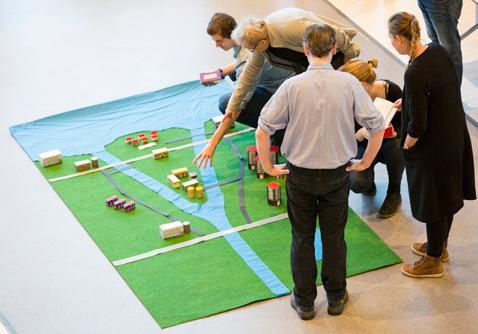
Photo source: https://www.kau.se/csr/om-csr/risklabr/riskkoping
Workshop E – Critical Infrastructures and Accessibility Analysis under Flood Conditions
Facilitated by Sai Ganesh Veeravalli and Stefanos Georganos and delivered by Amalia Nikoleta Chantziara from the Swedish Competence Centre for Satellite Enabled Social Science Analytics (SESAC)
Date: 8 October 2026
Time: 13:00 – 14:30
Capacity: Maximum 30 participants
Language: English
This workshop introduces participants to Earth Observation (EO), Geographical Information Systems (GIS), and basic spatial analysis for understanding both the direct and indirect impacts of flooding on critical infrastructure, road networks, and accessibility. It is designed as an entry-level, hands-on training session that makes complex geospatial datasets more accessible and applicable in practice.
The analysis is based on a realistic flood scenario in Sweden, where extreme precipitation leads to river and lake overflow, widespread flooding, and surface-water accumulation. Roads become inundated, disrupting access to essential facilities such as hospitals and emergency services.
Participants will work around a central question:
How does flooding change accessibility, and who is most affected?
Using flood hazard outputs, GIS layers, road-network data, critical-infrastructure locations, and demographic information, participants will explore how different datasets can be combined to understand real-world impacts and support societal resilience. Through guided examples and user-friendly tools, the workshop follows the full analytical chain — from flood exposure mapping to accessibility assessment and interpretation of the resulting impacts.
The overall goal is to bridge scientific methods with society-centred applications and foster interdisciplinary collaboration across the natural and social sciences. The workshop is open to students at all levels, researchers, practitioners, stakeholders, and professionals. No prior programming experience is required.
Registration
Participants registered for RisCon26 will select their preferred workshops separately through the conference registration system and will receive confirmation of their placement.
The workshop is also open to participants who have received a special invitation through the SESAC network and who are not otherwise registered for RisCon26. Participation through this route is free of charge, with the 300 SEK workshop fee covered by SESAC.
SESAC-only registration: https://sola.kau.se/csrworkshop/
Deadline: 21 September 2026